Book reading s,TV series transcript s,comedy, personal, Red circle podcast, Book Review s,Interviews, its popcorn for the brain.
Blog copyright Mark Antony Raines
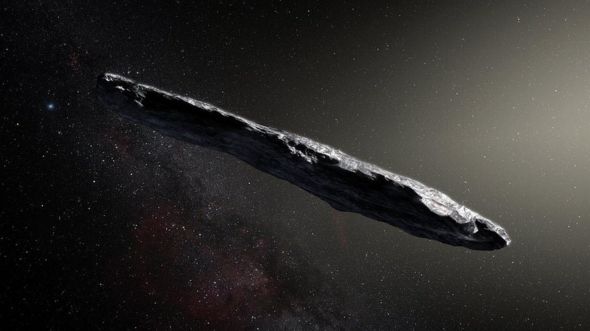
Using observations from the Very Large Telescope in Chile, Karen Meech, from the Institute for Astronomy in Honolulu, Hawaii, and colleagues determined that the object was about 400m long, rapidly rotating and subject to dramatic changes in brightness.
These changes in brightness were the clue to 'Oumuamua's bizarre shape.
"Looking at the asteroid light curve database, there are five objects (out of 20,000) that have light curves that would suggest a shape up to an axis ratio of about 7-8 to 1," Dr Meech told BBC News.
"Our errors are very small, so we are confident this is really elongated. Also, one has to realise we don't know where the rotation pole is pointed. We assumed that it was perpendicular to the line of site. If it were tipped over at all, then there are projection effects and the 10:1 is a minimum. It could be more elongated!"
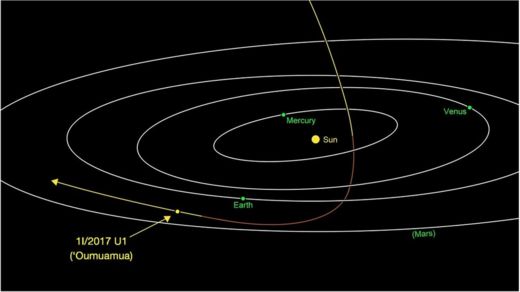
Image copyrightNASA/JPL-CALTECH/IAUImage captionThe object's velocity and eccentric trajectory suggests it originated outside our Solar System
But in other respects, 'Oumuamua (pronounced oh MOO-uh MOO-uh), appears to resemble objects we know from closer to home.
"We also found that it had a reddish colour, similar to objects in the outer Solar System, and confirmed that it is completely inert, without the faintest hint of dust around it," Dr Meech said.
These properties suggest that 'Oumuamua is dense, comprised of rock and possibly metals, has no water or ice, and that its surface was reddened due to the effects of irradiation from cosmic rays over long periods of time.
Although 'Oumuamua formed around another star, scientists think it could have been wandering through the Milky Way, unattached to any star system, for hundreds of millions of years before its chance encounter with our Solar System.
"For decades we've theorised that such interstellar objects are out there, and now - for the first time - we have direct evidence they exist," said Thomas Zurbuchen, associate administrator for Nasa's science mission directorate in Washington DC.
"This history-making discovery is opening a new window to study formation of solar systems beyond our own."
If planets form around other stars the same way they did in the Solar System, many objects the size of 'Oumuamua should get slung out into space. The interstellar visitor may provide the first evidence of that process.
Image copyrightESO/F. KAMPHUESImage captionThe Very Large Telescope in Chile was used for observations
As regards how 'Oumuamua became so elongated, Dr Meech explained: "There has been speculation among various team members about this. Sometimes very elongated objects are contact binaries... but even so, the pieces would be longer than most things in the Solar System, and our analysis shows that it is rotating fast enough that they should not stay together.
"One of our team wondered if, during a planetary system formation, if there was a large collision between bodies that had molten cores, some material could get ejected out and then freeze in an elongated shape.
"Another team member was wondering if there could be some process during the ejection - say if there was a nearby supernova explosion that could be responsible."
The cosmic interloper was discovered by Rob Weryk, a postdoctoral researcher at the Institute for Astronomy and a co-author of the new study, which is published in Nature journal.
Weryk and fellow Institute for Astronomy researcher Marco Micheli realised it was going extremely fast (with enough speed to avoid being captured by the Sun's gravitational pull) and was on a very eccentric trajectory taking it out of our Solar System.
The asteroid's name, 'Oumuamua, means "a messenger from afar arriving first" in Hawaiian.
Hi mark I was told off platform by a medium long ago in Stockwell church I will be doing something with herbs well now I was definitely not a plant tree or nature person and one day I lefted my hse went into a garden shop spent some money on herbs that's what the man said and I just came home put them on my living floor and they sat their for a few days my younger son said mum I think those plants need water and sun so I got up and put them on window ledge gave them some water didn't know how much to give them several days later I came home with a tough I didn't know how to use it I just put several herbs into it water it lefted it on window sill then one eve I was woken up during the night and walked into my living room where I stood by window and noticed the lights the moon something made me look at the herbs and they were all standing up right so went over as I knew these plants were in fact laying down and then as I bent down to see them more closer what I saw amazed me then I had a special magical moment what I saw was so amazing I had always asked God that all I want to see in this life is something small something that can cure help people even heal people and right before my eyes they were all standing in line and all upright and not one single herb out of place this piece of magic blew me out and I went to bed next morn all these plants had layed down to the way they were when I brought them later on in a few weeks time I go to Brixton lib and get a book on herbs because that's all I knew they were called and read that plants react to the moon from this book I learnt about herbs plus other books and then a while later I go on an outing to Brighton I go into a ho cus poscus shop that's the name and was drawn very much so to a pack of cards that were herbal on the way home I see the cards were herbal I had to laugh to myself then I started to do readings with this herb and still do ok also I went on to growing herbs at home on a balcony when I moved I grew herbs on a private balcony and invited people to see them organisations as well also i grew salad flowers etc veg what ever I could I had one time 70 to 75 herbal books plus 140 dried herbs at home I was bonkers about them totally nuts everything was herbal I grew them made up teas medicine disinfectant herbal butter then made designed my own book called herbal recipe teas by me and got it on line as well I also did herbal fetes country shows and then herbal tea talks and demos as well for both men women 2 hours talks in lib colleges coffee Mornings etc ok as for now I still use my herbal cards and also still grow herbs but no garden or balcony but that has never stopped me plus also been doing herbal events here with another person and probably will do some next year ok I think that's quite a bit if you want to know anymore please get in touch ok author hse was my publishers and my book is available on lots of other we'd sites my whole outlook on herbs is about the history and education ok linda
Once a pressure injury (pressure ulcer) has developed, immediate treatment is required. [10] Commonly used treatments over the years have included innovative mattresses, ointments, creams, solutions, dressings, ultrasonography, ultraviolet heat lamps, sugar, and surgery. In choosing a treatment strategy, consideration should be given to the stage of the wound and the purpose of the treatment (eg, protection, moisture, or removal of necrotic tissue). An algorithm for assessment and treatment is available. [57, 76, 77]
General principles of wound assessment and treatment are as follows:
Wound care may be broadly divided into nonoperative and operative methods
For stage 1 and 2 pressure injuries, wound care is usually conservative (ie, nonoperative)
For stage 3 and 4 lesions, surgical intervention (eg, flap reconstruction) may be required, though some of these lesions must be treated conservatively because of coexisting medical problems [3]
Approximately 70-90% of pressure injuries are superficial and heal by second intention
With thorough and comprehensive medical management, many pressure injuries may heal completely without the need for surgical intervention. Successful medical management of pressure ulcers relies on the following key principles:
Reduction of pressure
Adequate débridement of necrotic and devitalized tissue
Control of infection
Meticulous wound care
If surgical reconstruction of a pressure injury is indicated, it cannot be emphasized too strongly that medical management must be optimized before reconstruction is attempted; otherwise, reconstruction is doomed to failure. That is, spasticity must be controlled, nutritional status must be optimized, and the wound must be clean and free of infection. If there is significant fecal soiling into the injury, diverting colostomy should be considered before reconstruction. If there is a urethral fistula, it should be diverted and healed before reconstruction.
Wound reconstruction can be considered once the bacterial load has been sufficiently minimized to reduce the risk of infectious complications. Furthermore, the patient’s social situation and nutritional status must be optimized (albumin level >3.5 g/mL) to reduce the risk of an adverse outcome.
Because the complication rate after pressure injury reconstruction can be extremely high, patients who are poor surgical candidates in general should not undergo this procedure. Those who do not have a proper support network and a pressure-release bed at home also are not good candidates for pressure injury reconstruction, because of the risk of recurrence or other complications. Patients who do not comply with nonoperative measures used to promote healing by secondary intention are poor reconstruction candidates as well.
Treatment options of unproven efficacy that are currently being studied include hyperbaric oxygen therapy, electrotherapy, growth factors, and negative-pressure wound therapy (NPWT). Initial studies of electrotherapy seem promising, and topical application of the recombinant human growth factor becaplermin has been approved for use in patients with diabetic neuropathic ulcers of the lower extremity. However, not enough evidence is available to permit these treatments to be recommended for the treatment of pressure injuries.
Discharge planning begins early in the hospital stay and requires an interdisciplinary approach. Knowledge of available resources facilitates smooth transitions through all levels of care. With more care being conducted in the home environment, education of the patient and caregiver in preventing and treating pressure injuries becomes increasingly important. Various methods can be used to facilitate the educational process, including charts, diagrams, photographs, and videos. This comprehensive approach can positively influence outcome. [77]
As a final note, some consideration should be given to the ethics of treating pressure injuries. For some individuals with pressure injuries, such as acutely hospitalized patients with a recoverable illness, aggressive treatment, as outlined in this article, is certainly indicated.
For other persons, however, such as chronically or terminally ill patients with long-standing or recurrent ulceration, aggressive treatment may not be in their best interests. In such instances, the wishes of the patient or the patient’s family should be weighed carefully. It may prove to be the case that the patient’s interests are better served by providing medical care and maintaining patient comfort than by instituting major invasive procedures.
In March 2015, the American College of Physicians (ACP) published clinical practice guidelines for risk assessment, prevention, and treatment of pressure ulcers (see Guidelines). [78, 79]=read more
The Partridge Family The Partridge Family is an American musical-sitcom starring Shirley Jones and featuring David Cassidy. Jones played a widowed mother, and Cassidy played the oldest of her five children who embarked on a music career. It ran from September 25, 1970, until March 23, 1974, on the ABC network as part of a Friday-night lineup, and had subsequent runs in syndication. The family was loosely based on the real-life musical family The Cowsills, a popular band in the late 1960s and early 1970s. The Partridge Family  Genre Musical sitcom Created by Bernard Slade Starring Shirley Jones David Cassidy Danny Bonaduce Susan Dey Suzanne Crough Jeremy Gelbwaks (1970–71) Brian Forster (1971–74) Dave Madden Theme music composer Diane Hilderbrand Danny Janssen Wes Farrell Opening theme "When We're Singin'" (1970–71) "C'mon, Get Happy" (1971–74) Ending theme "Never Need to Think" (1973–74) Composer(s) George Duning Benny Golson Warren Barker Hugo Montenegro Shorty Rogers Country of origin United States Original language(s) English No. of seasons 4 No. of episodes 96 (list of episodes) Production Executive producer(s) Bob Claver Producer(s) William Bickley Paul Junger Witt Dale McRaven Larry Rosen Mel Swope Cinematography Fred Jackman, Jr. Irving Lippman Camera setup Single-camera Running time 25 minutes Production company(s) Screen Gems Television (1970–1974) Distributor Columbia Pictures Television (1974–84; 1989–96) DFS Program Exchange (1984–87) The Program Exchange (1987–89) Columbia TriStar Television (1996–2002) Sony Pictures Television (2002–present) Release Original network ABC Audio format Monaural Original release September 25, 1970 – March 23, 1974 Chronology Related shows Getting Together Goober and the Ghost Chasers Partridge Family 2200 A.D. Premise History Cast and characters Episodes Production Broadcast history Reception
I rang up phone in for up all night virtual jukebox to recommend a live and loud song which was ace of spades by motorhead. The reason being that I saw them at cliff pavilion in Southend on Sea Essex were i was next to the speakers and was a bit deaf the next day. The glitch was fact I could hear the show on my mobile phone but not able to get on. I rerung them and talked to a nice lady who said sorry as we're trying to get through to me but got answer phone told to turn mobile phone off and rering but got no joy such is life .